
Why it matters
Hampi offers an unusually extensive view of an imperial South Indian capital, from sacred centres to royal and hydraulic infrastructure.
History & context
Hampi, on the Tungabhadra river in Karnataka, preserves the ruins of Vijayanagara ("City of Victory"), capital of one of the largest empires in Indian history. Founded in the fourteenth century by Harihara and Bukka of the Sangama dynasty, the city grew into a vast, wealthy metropolis. Foreign visitors such as Domingo Paes in the sixteenth century described its markets, festivals and fortifications. Its high point came under Krishnadevaraya (r. 1509–1529), a patron of temples and literature. In 1565 the empire was defeated by an alliance of Deccan sultanates at the Battle of Talikota, and the capital was sacked and abandoned. Today the ruins spread over more than 25 square kilometres among granite boulders: temple complexes, bazaar streets, royal platforms, aqueducts and tanks. The Virupaksha temple is still in worship. Hampi became a UNESCO World Heritage Site in 1986.
Architecture & landscape
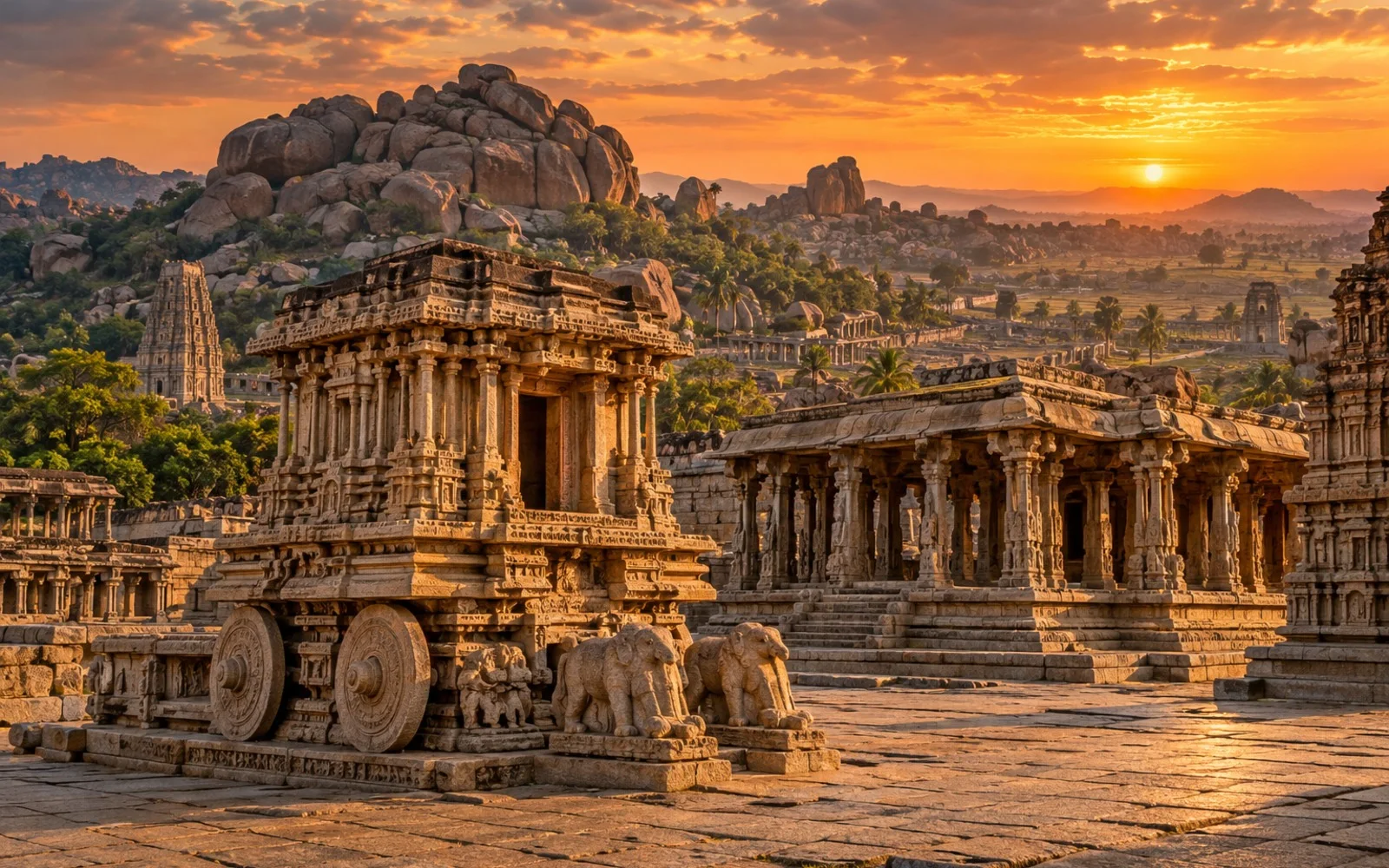
Highlights include the Vitthala temple with its stone chariot and musical pillars, the towering gopura of the Virupaksha temple, the Lotus Mahal and Elephant Stables, the stepped tank in the royal enclosure, and the Mahanavami platform.
Timeline
1336 CE
Vijayanagara polity founded
1509 CE
Krishnadevaraya begins his reign
1565 CE
Battle of Talikota and major disruption
1986 CE
Inscribed as a UNESCO World Heritage Site
Story
The rise of Vijayanagara
How a new imperial capital grew along the Tungabhadra.
Story
Water engineering
Channels, tanks and aqueducts sustained the capital and its cultivated landscape.