
Why it matters
Dholavira shows how one of the world's earliest urban societies planned a city around water in a harsh environment.
History & context
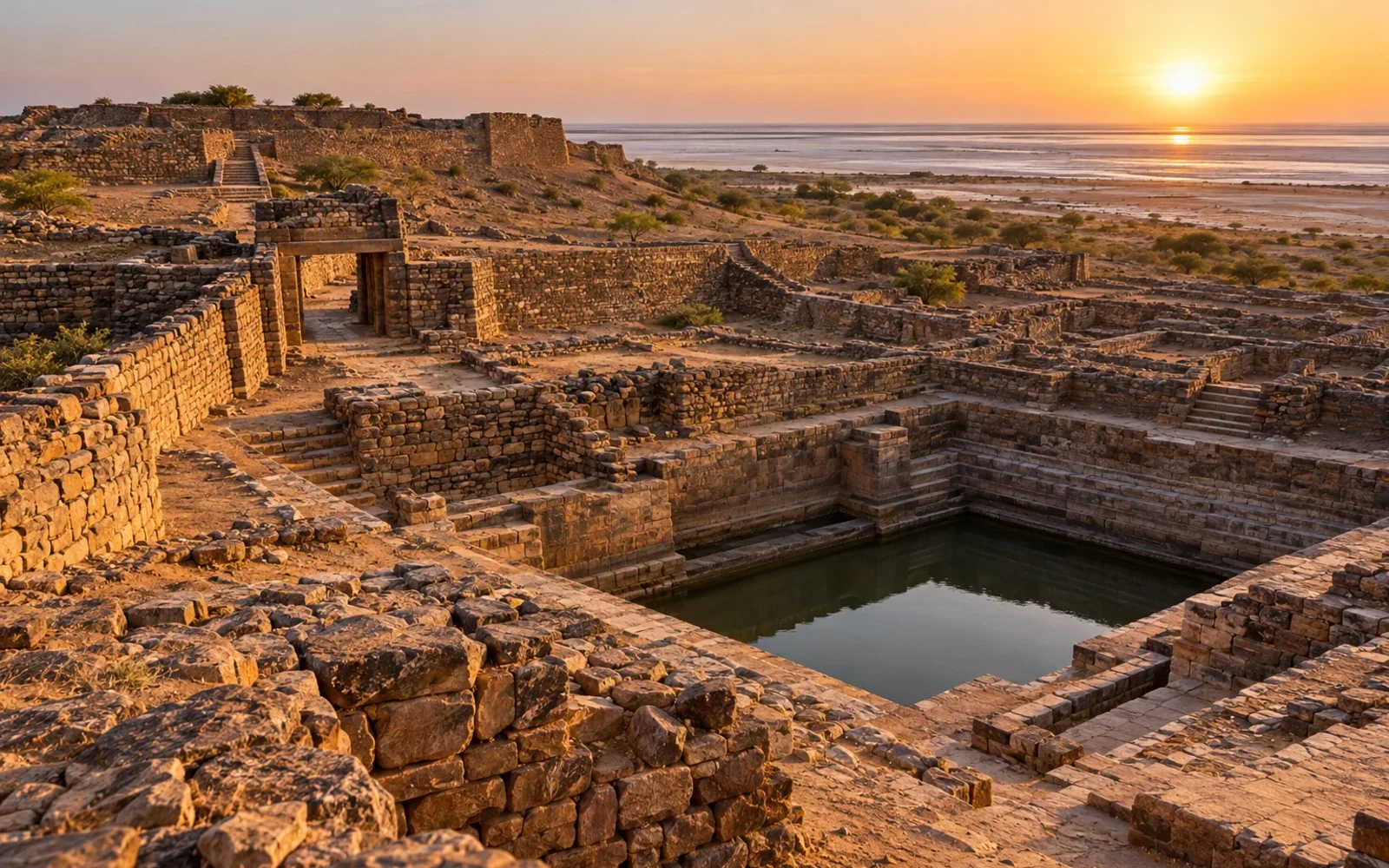
Dholavira, on Khadir Bet island in the Rann of Kutch, Gujarat, is one of the largest and most remarkable cities of the Harappan (Indus) Civilization. It was occupied from around 3000 BCE and flourished between about 2500 and 1900 BCE. The city was divided into a citadel, a middle town and a lower town, all fortified. Its people built a network of reservoirs, dams and drains to collect and store scarce water. Excavators found a large inscription of ten Harappan signs, sometimes called the world's earliest signboard. The site was found in 1967–68 and excavated from 1990 by R. S. Bisht of the Archaeological Survey of India. It became a UNESCO World Heritage Site in 2021.
Architecture & landscape
Walls, gates, reservoirs and drains are built of stone, unlike the brick of many other Harappan cities.
Timeline
c. 3000 BCE
Settlement begins
c. 2500–1900 BCE
Mature Harappan city
1967–68
Site discovered
1990 CE
Major excavations begin
2021 CE
Inscribed as a UNESCO World Heritage Site