
Why it matters
The Qutb complex marks the beginnings of Indo-Islamic architecture in north India.
History & context
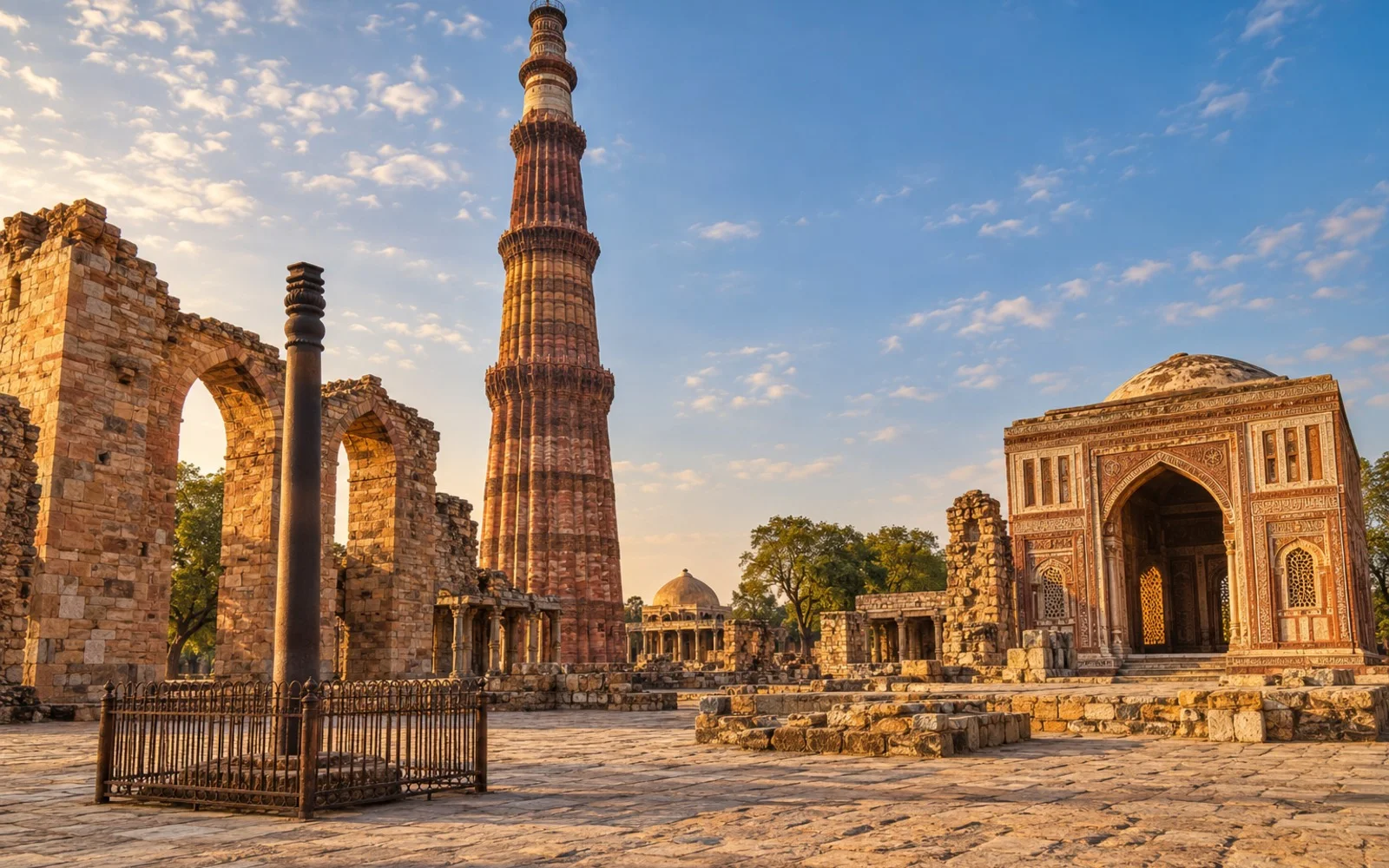
The Qutb complex, in south Delhi, contains some of the earliest monuments of the Delhi Sultanate. After the Ghurid conquest of Delhi, Qutb-ud-din Aibak began the Quwwat-ul-Islam mosque in the 1190s, reusing columns from earlier temples, and started the Qutb Minar around 1199. His successor Iltutmish added storeys, and Firuz Shah Tughlaq repaired the top after a lightning strike in the fourteenth century. The complex also contains the Iron Pillar, a Gupta-period pillar of the fourth–fifth century known for its resistance to rust, the Alai Darwaza gateway built in 1311 by Alauddin Khalji, and the tomb of Iltutmish. The Qutb Minar, about 73 metres tall, became a UNESCO World Heritage Site in 1993.
Architecture & landscape
The fluted minar is built in red and buff sandstone with bands of calligraphy. The Alai Darwaza is an early example of true arches and a dome in India.
Timeline
4th–5th century
Iron Pillar made
c. 1199
Qutb Minar begun
1311 CE
Alai Darwaza built
1993 CE
Inscribed as a UNESCO World Heritage Site