
Why it matters
The Brihadisvara temple is a defining monument of Chola power and of Dravida architecture.
History & context
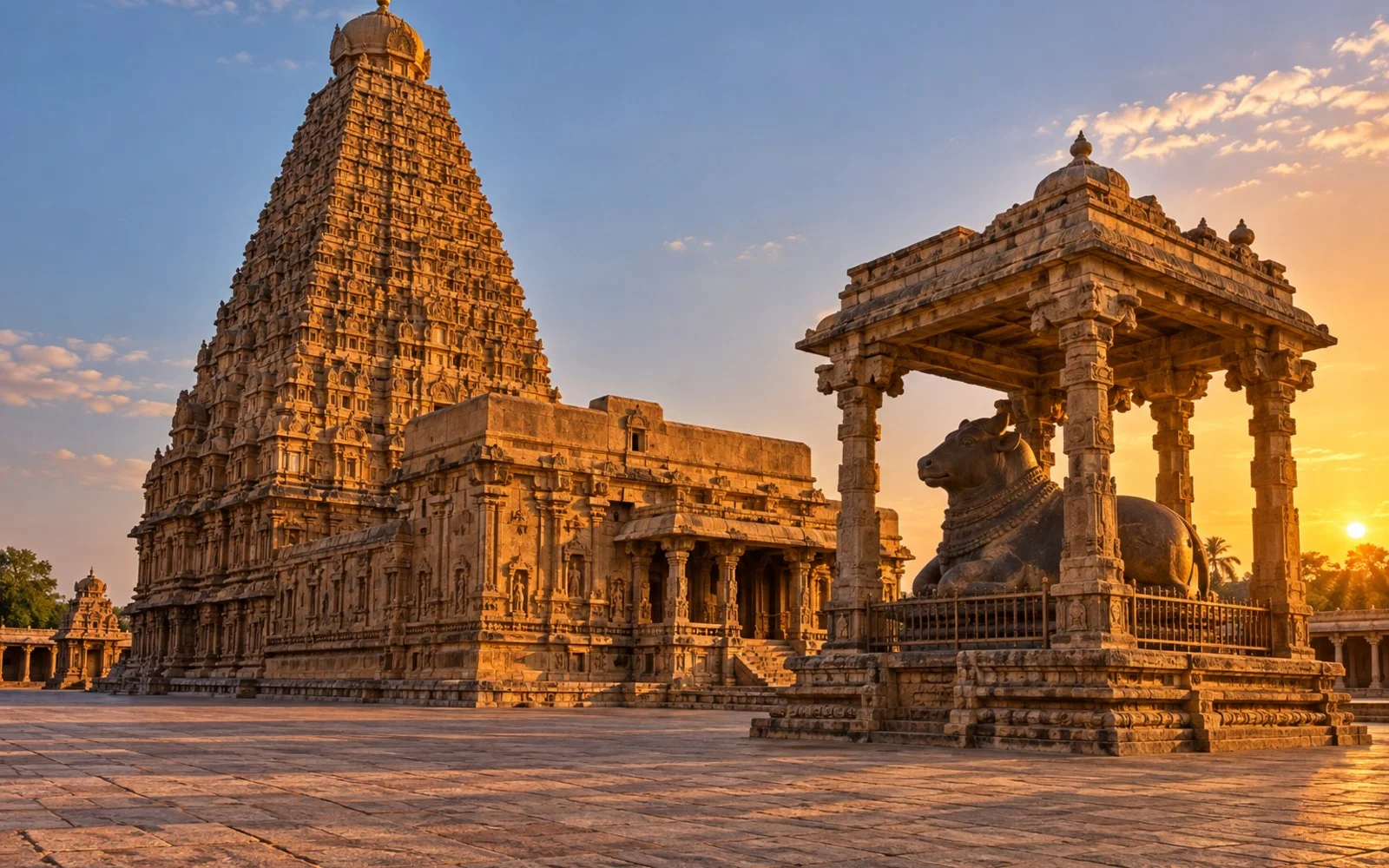
Thanjavur, in the Kaveri delta of Tamil Nadu, was the capital of the Chola Empire at its height. Its great Brihadisvara temple (Rajarajeshwaram) was built by Raja Raja Chola I and completed in 1010. With its vimana (tower) rising about 66 metres, it was one of the largest buildings in India at the time. Inscriptions on the temple walls record the king's gifts, temple staff, dancers and lands, giving rare detail about how a medieval temple worked. Chola-period murals survive inside, partly under later Nayaka paintings. Later, Thanjavur was ruled by the Nayakas and then the Marathas, whose ruler Serfoji II expanded the Saraswati Mahal Library. The temple is part of the UNESCO World Heritage Site "Great Living Chola Temples".
Architecture & landscape
The granite vimana rises in thirteen storeys to a capstone weighing many tonnes. A colossal monolithic Nandi faces the sanctum.
Timeline
985 CE
Raja Raja Chola I becomes king
1010 CE
Brihadisvara temple completed
1670s
Maratha rule begins in Thanjavur
1987 CE
Inscribed as a UNESCO World Heritage Site