
Why it matters
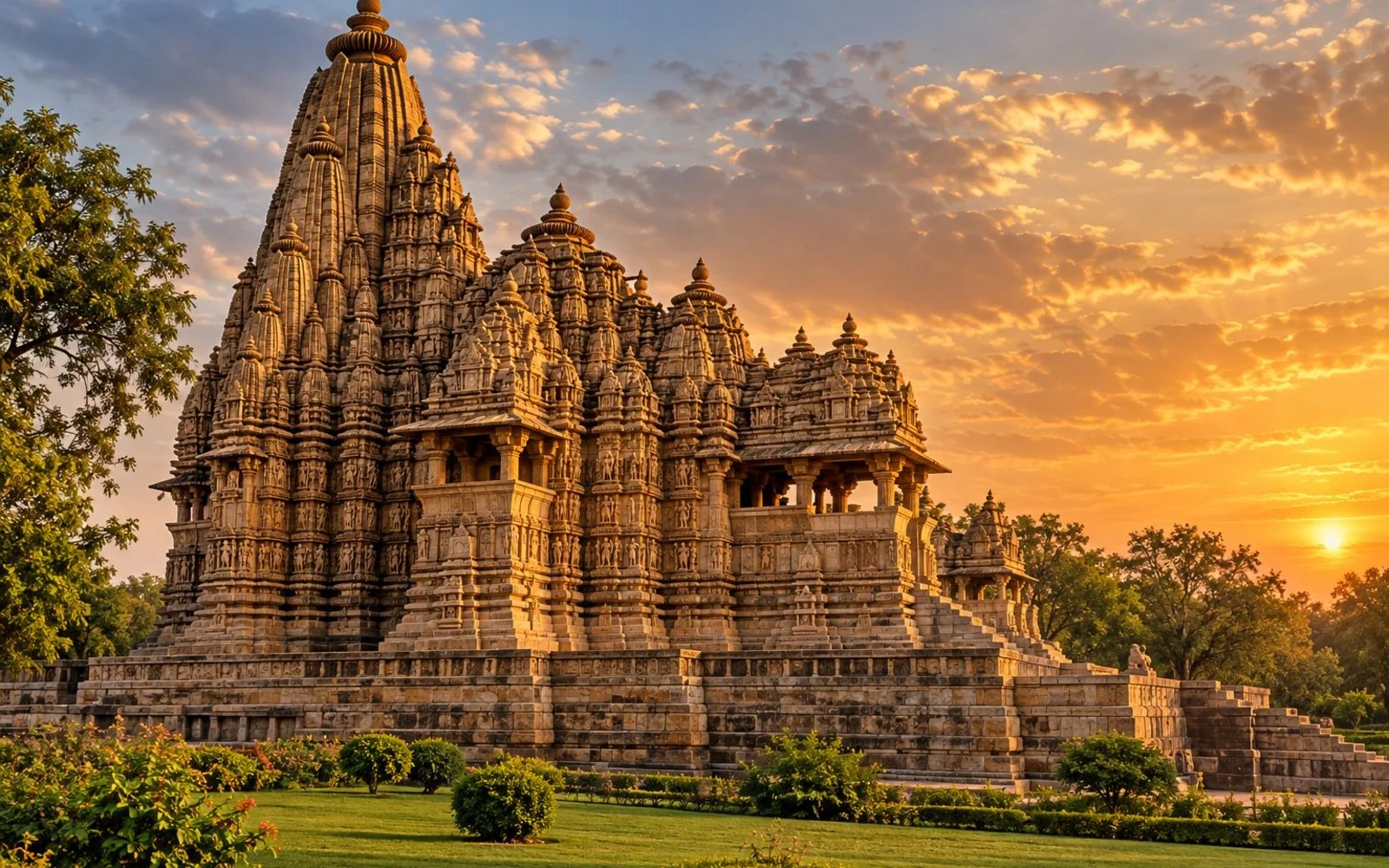
Khajuraho represents a peak of the north Indian Nagara temple style.
History & context
Khajuraho, in Madhya Pradesh, was a religious centre of the Chandela dynasty. Of about eighty-five temples built mainly between 950 and 1050, around twenty-five survive, dedicated to Shiva, Vishnu and the Jain tirthankaras. The temples are known for their soaring towers and dense sculptural decoration, showing gods, celestial women, musicians, warriors and, in a small share of panels, erotic scenes. The Lakshmana temple (with an inscription of 954) and the Kandariya Mahadeva temple are among the finest. After the Chandelas declined, the site fell out of use; a British officer recorded it in 1838. It became a UNESCO World Heritage Site in 1986.
Architecture & landscape
Each temple stands on a high platform, with a sequence of halls whose roofs rise like mountain peaks towards the main tower.
Timeline
954 CE
Lakshmana temple dedicated
c. 1030
Kandariya Mahadeva temple built
1986 CE
Inscribed as a UNESCO World Heritage Site